CME information and disclosures
To see contributor disclosures related to this article, click on this reference: [1]
Physicians can earn CME/MOC credit by using this article to address a clinical question and completing a brief evaluation about how they applied the information in their practice.
AMBOSS designates this internet point-of-care activity for a maximum of 0.5 AMA PRA Category 1 Credit(s)™. Physicians should claim only the credit commensurate with the extent of their participation in the activity.
For answers to questions about AMBOSS CME, including how to redeem CME/MOC credit, see “Tips and links” at the bottom of this article.
Summary
Diabetes mellitus (DM) in pregnancy consists of gestational diabetes mellitus (GDM) and pregestational diabetes mellitus. GDM is an abnormal glucose tolerance that develops during pregnancy, while pregestational diabetes mellitus is DM that is present before conception. Both conditions are associated with an increased risk for maternal and fetal complications. Individuals with pregestational DM may have clinical features of DM, whereas individuals with GDM are usually asymptomatic. Early detection and management of diabetes in pregnancy is essential to reduce complications. Screening for GDM is recommended for all individuals at 24–28 weeks' gestation; high-risk individuals should be additionally screened at the initial prenatal visit for undiagnosed pregestational diabetes. Management of diabetes in pregnancy usually involves a multidisciplinary team including endocrinology, maternal-fetal medicine, and dietitians. If medication is required, insulin is recommended. Patients require careful monitoring; antepartum fetal surveillance is usually recommended from 32 weeks' gestation because of the high rate of fetal complications. GDM usually resolves after delivery, and patients with GDM should be assessed for resolution at 4–12 weeks postpartum. Patients with GDM are at elevated lifetime risk of diabetes mellitus and require ongoing screening for diabetes every 1–3 years.
Overview
| Overview of diabetes in pregnancy | ||
|---|---|---|
| Features | Gestational diabetes mellitus [2][3] | Pregestational diabetes mellitus [4] |
| Definition |
|
|
| Epidemiology |
|
|
| Pathophysiology |
|
|
| Risk factors |
|
|
| Clinical features |
|
|
| Screening and diagnosis [4] |
|
|
| Treatment |
|
|
| Complications |
|
|
| Prognosis [5] |
|
|
Screening
Screening for undiagnosed pregestational diabetes [6][7]
- Indications: any preexisting indication for diabetes screening
-
Modality: Perform either of the following at the initial prenatal visit (see “Interpretation of hyperglycemia studies” for results).
- HbA1c testing (before 15 weeks' gestation only)
- Fasting blood glucose
-
Follow-up
- Screen positive: Manage as pregestational diabetes.
- Screen negative: Perform routine screening for GDM.
HbA1c is not reliable after 15 weeks' gestation because of rapid red blood cell turnover in pregnancy. [7]
Screening for GDM [6][8][9]
- Indications: all individuals without pregestational diabetes
- Modality: OGTT at 24–28 weeks' gestation (see “Diagnosis of GDM” for details)
-
Follow-up
- Screen positive: Manage as GDM.
- Screen negative: No further testing is necessary unless clinical features of DM develop.
Diagnosis
Perform diagnostics for any individual with clinical features of DM. Diagnostic studies are otherwise performed as part of routine screening for diabetes in pregnancy.
Diagnosis of pregestational diabetes
See “Diagnosis of diabetes mellitus.”
Diagnosis of GDM
- Modality: either two-step OGTT (preferred) or one-step OGTT [6][7]
-
Interpretation of results [5][7]
-
One-step OGTT: GDM is confirmed if any of the following values are obtained.
- Fasting glucose ≥ 92 mg/dL
- 1-hour glucose ≥ 180 mg/dL
- 2-hour glucose ≥ 153 mg/dL
-
Two-step OGTT: GDM is confirmed if ≥ 2 of the following values are obtained. [7]
- Fasting glucose ≥ 95 mg/dL
- 1-hour glucose ≥ 180 mg/dL
- 2-hour glucose ≥ 155 mg/dL
- 3-hour glucose ≥ 140 mg/dL
-
One-step OGTT: GDM is confirmed if any of the following values are obtained.
Management
Most pregnant individuals with diabetes are referred to specialists (e.g., endocrinology, maternal-fetal medicine) for management.
Prenatal care
All patients [10][11]
- Initiate routine prenatal care.
- Offer supportive services (e.g., social work, diabetes education).
- Address coexisting conditions related to diabetes (e.g., obesity, hypertensive pregnancy disorders, ASCVD).
- Discuss glycemic control in pregnancy. [4]
- Initiate antepartum fetal surveillance based on risk factors. [4][5]
- Pregestational DM or GDM that is poorly controlled or needs medication: Usually from 32 weeks' gestation
- Well-controlled diet-controlled GDM: Fetal surveillance may not be required, follow local guidance.
Patients with pregestational diabetes [4]
- Obtain the following at the first prenatal visit:
- HbA1c
- Thyroid function tests
- ECG
- Diabetic retinopathy screen [5][10]
- 24 hour urine profile (if no baseline)
- Adjust medications as necessary (see “Antihyperglycemic treatment in pregnancy” and “Pharmacotherapy during pregnancy”). [4][10]
- Educate on the increased risk of diabetic ketoacidosis and hypoglycemia during pregnancy. [4]
- Advise patients to check urinary ketones if glucose levels exceed 200 mg/dL.
- Discuss hypoglycemia management; ensure patients carry glucose tablets and glucagon.
- Screen for hypertensive pregnancy disorders; start aspirin prophylaxis against preeclampsia at 12–16 weeks. [4][10]
Patients with GDM [5]
- Advise that most individuals can control GDM with diet and exercise. [5][10]
- Refer to a dietitian to plan meals and snacks.
- Recommend 30 minutes of moderate-intensity exercise at least 5 days a week.
- Review glycemic control and start antihyperglycemic treatment in pregnancy if lifestyle changes alone are insufficient. [12]
Good glycemic control during pregnancy reduces the risk of maternal and fetal complications. [4]
Peripartum management [4][5]
-
Timing of delivery [4][5]
- Well-controlled DM: at 39 weeks' gestation [5]
- Poorly controlled DM, previous stillbirth, or existing complications of diabetes : 37–38 weeks' gestation
-
Mode of delivery [4]
- Usually vaginal
- Consider cesarean delivery if estimated fetal weight is ≥ 4500 g.
-
Medication management
-
Insulin management during delivery [4]
- Patients on insulin are usually maintained on long-acting insulin and started on an insulin infusion for delivery
- Blood glucose is checked hourly; target serum glucose is < 110 mg/dL.
- After delivery
- Patients with pregestational diabetes: Reduce insulin doses immediately after delivery to one-third to one-half of previous levels. [4]
- Patients with GDM: Stop antihyperglycemic medication immediately after delivery. [10]
-
Insulin management during delivery [4]
Delivery is recommended at a facility able to manage peripartum insulin delivery and common complications (e.g., shoulder dystocia, neonatal hypoglycemia). [4][5]
Postpartum care
All patients [4][5]
- Initiate standard postpartum care including postpartum contraception for all patients.
- Encourage breastfeeding. [11]
- Offer lifestyle recommendations for patients with diabetes mellitus.
Patients with pregestational diabetes [4]
- Discuss glycemic control with breastfeeding. [4]
- Advise individuals that erratic sleep and eating and reduced insulin requirements increase the risk of hypoglycemia. [10]
- Continue standard diabetes management.
Patients with GDM [5]
- Assess for resolution of GDM at 4–12 weeks' postpartum using the one-step OGTT. [5][10][11]
- Further management depends on the results. [5][10]
- Normal level: Screen for diabetes every 1–3 years. [10]
-
Impaired glucose tolerance
- Advise weight loss and exercise.
- Consider metformin.
- Screen for diabetes yearly.
- Positive diabetes screen: Initiate diabetes management.
A history of GDM increases the risk of developing T2DM. Advise patients to plan for future pregnancies by optimizing weight, nutrition, and glucose control before conception. [10]
Glycemic control in pregnancy
Advise patients that near physiologic glucose control decreases the risk of complications of diabetes in pregnancy. [4]
Monitoring
- Monitor HbA1c monthly. [10][13]
- Review home glucose monitoring records. [4][5][10]
- ≤ 24 weeks' gestation: every 1–2 weeks
- > 24 weeks' gestation: weekly
| Glycemic targets during pregnancy [4][10] | |
|---|---|
| Thresholds | |
| HbA1c |
|
| Fasting glucose [5] |
|
| Postprandial glucose [5] |
|
Hypoglycemia thresholds vary, but blood glucose levels < 70 mg/dL are generally considered too low. [10]
Antihyperglycemic treatment in pregnancy
- Medication is usually started by a specialist.
-
Insulin is recommended for all patients requiring medication to control diabetes during pregnancy. [4][5][10]
- Use a multiple dose regimen of rapid or short-acting insulin and intermediate or long-acting insulin. [4][5]
- Pregestational diabetes: Starting dose depends on the trimester. [4]
- Gestational diabetes: starting dose 0.7–1.0 units/kg/day [4]
- Tailor insulin doses; requirements: [4]
- May decrease in the first trimester
- Increase in the second and third trimester
- Typically increase if antenatal corticosteroids for fetal maturation are used [4]
- Use a multiple dose regimen of rapid or short-acting insulin and intermediate or long-acting insulin. [4][5]
- For patients unwilling or unable to take insulin, oral antidiabetic medications can be used off-label.
- Options: metformin (preferred), glyburide [4][5][10]
- Use shared decision-making. [5]
Complications
Pregestational diabetes poses a greater risk of complications than gestational diabetes. Complications during the first trimester are more common in pregestational diabetes, while complications during the second and third trimesters are equally associated with pregestational and gestational diabetes. [14]
We list the most important complications. The selection is not exhaustive.
Maternal complications of diabetes in pregnancy
- Hypertensive pregnancy disorders
- Urinary tract infection in pregnancy [15]
- Spontaneous abortion
- Worsening of complications of DM (e.g., diabetic retinopathy)
- Hypoglycemia
- Hyperglycemic crises
- Preterm labor
- Polyhydramnios
- Postpartum hemorrhage [16]
- Need for cesarean delivery
- Increased long-term risk of developing T2DM
Fetal and neonatal complications of diabetes mellitus in pregnancy
Diabetic embryopathy
- Definition: any anomaly in an embryo associated with maternal diabetes, typically developing during the main embryonic period
- Onset: first trimester
- Pathophysiology: hyperglycemia → inhibition of myo-inositol uptake → abnormalities in the arachidonic acid-prostaglandin pathway → congenital anomalies and early pregnancy loss [14]
Manifestations of diabetic embryopathy [14]
- Early pregnancy loss and perinatal death
-
Cardiovascular defects: congenital heart disease
- Transposition of the great vessels
- Ventricular septal defect
- Truncus arteriosus
- Coarctation of the aorta
- Patent ductus arteriosus
-
Central nervous system defects: neural tube defects
- Anencephaly
- Spina bifida
- Myelomeningocele
-
Genitourinary defects
- Renal agenesis
- Ureteral duplication
- Hydronephrosis
-
Skeletal defects
-
Caudal regression syndrome: a congenital condition characterized by the partial or complete absence of the sacrum and often of the lower lumbar spine
- Pathophysiology: The cause of caudal regression syndrome is unknown.
- Maternal diabetes is a known risk factor.
- Clinical features: based on the level of the spinal lesion and disease severity
- Lower limb deformities or foot deformities (e.g., club foot)
- Anorectal malformations
- Aplasia or hypoplasia of the sacrum and/or lumbosacral spine
- Mild to severe motor function impairment and paralysis
- Flat buttocks and shallow gluteal clefts
- Bowel and bladder dysfunction (e.g., neurogenic bladder, bladder incontinence)
- May occur as part of other caudal syndromes (e.g., VACTERL, OEIS syndrome)
- Vertebral anomalies (e.g., hemivertebrae)
-
Caudal regression syndrome: a congenital condition characterized by the partial or complete absence of the sacrum and often of the lower lumbar spine
-
Gastrointestinal defects
- Small left colon syndrome: an abrupt decrease in intestinal diameter characterized by transient intestinal obstruction due to inability to pass meconium
- Duodenal atresia
- Anorectal malformation
- Other: cleft palate

Diabetic fetopathy
- Definition: any anomaly in a fetus associated with maternal diabetes, caused by fetal hyperinsulinemia during gestation
- Onset: second and third trimesters
- Pathophysiology: maternal hyperglycemia → fetal hyperglycemia → stimulation of fetal pancreas → fetal hyperinsulinemia → ↑ metabolic rate, oxygen consumption, and fetal hypoxemia → metabolic, respiratory, and cardiovascular complications
Manifestations of diabetic fetopathy [14]
- Growth defect: : fetal macrosomia
-
Metabolic defects
- Neonatal hypoglycemia: maternal hyperglycemia → fetal hyperglycemia → beta cell hypertrophy and hyperfunctioning → fetal and neonatal hyperinsulinemia → transient hypoglycemia after birth (when maternal glucose supply stops)
- Neonatal polycythemia: maternal hyperglycemia → chronic fetal hyperglycemia → ↑ metabolic effects and oxygen demand → fetal hypoxemia → ↑ erythropoietin concentrations→ ↑ erythrocyte count
- Neonatal hypocalcemia and neonatal hypomagnesemia: maternal hyperglycemia → abnormal maternal calcium-phosphorus metabolism → ↑ maternal urinary Mg excretion → maternal hypomagnesemia → fetal hypomagnesemia → impaired PTH synthesis in the fetus → fetal hypocalcemia and hypomagnesemia
-
Respiratory defects
- Acute respiratory distress syndrome
- Transient tachypnea of the newborn
- Perinatal asphyxia
-
Cardiovascular defects: transient hypertrophic cardiomyopathy
- Definition: thickening of one or both of the ventricular walls and the interventricular septum
- Clinical features: often asymptomatic in infants but may manifest with symptoms of heart failure (e.g., tachypnea, poor feeding, irritability)
- Pathophysiology: maternal hyperglycemia → fetal hyperglycemia → fetal hyperinsulinemia → ↑ fat and glycogen in fetal myocardial cells → thickening of ventricular walls and the intraventricular septum in utero → ↓ ventricular size → left ventricular outflow obstruction and systolic and diastolic cardiac dysfunction
- Diagnostics: echocardiography showing thickened ventricular walls and interventricular septum
- Management: supportive care(e.g., intravenous fluids, beta blockers) for symptomatic infants
- Prognosis: Symptoms typically resolve as plasma insulin normalizes.
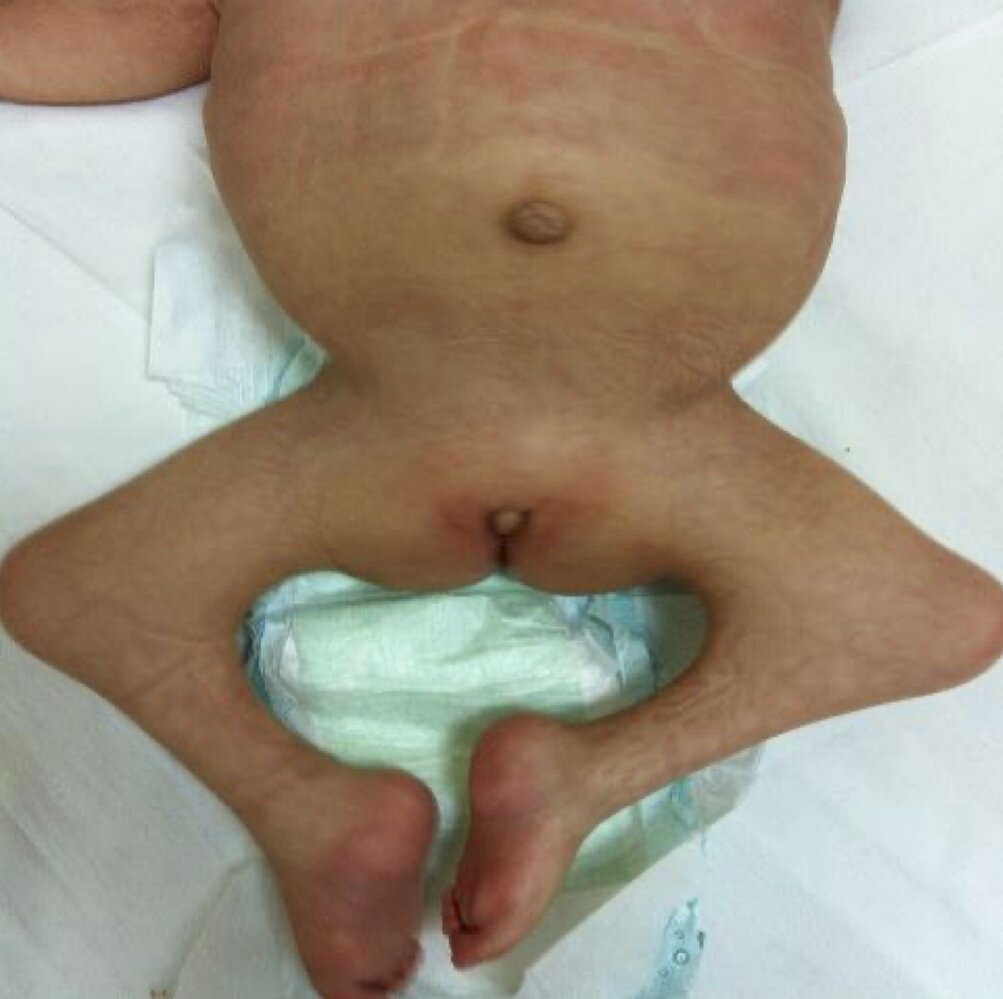
Lower abdomen and legs of a 2.5-year-old girl of a diabetic mother with poor glycemic control during pregnancy:
The hips and lower extremities appear hypoplastic and showed no muscular activity during the clinical examination. Orthopedic deformities included knees in a flexion contracture and equinovarus feet.
These findings are consistent with caudal regression syndrome. X-ray and MRI of the spine confirmed total sacral and partial lumbar vertebrae agenesis and termination of the spinal cord at T6.
Source: “Figure 1, in: A case of caudal regression syndrome: walking or sitting?” by Irem Bicakci et al., The Pan African Medical Journal, licensed under CC BY 2.0.
Prevention
- As part of routine preconception care: [11]
- Advise patients on weight management, diet, and exercise.
- Test individuals with indications for diabetes screening.
- In the first trimester: Recommend a healthy diet and regular exercise (see “Prenatal patient education”) to reduce the risk of GDM. [10]
External Resources
- 2025 ADA Standards of Care in Diabetes: Diagnosis and Classification of Diabetes
- 2025 ADA Standards of Care in Diabetes: Management of Diabetes in Pregnancy
- 2024 ACOG Clinical Practice Update: Screening for Gestational and Pregestational Diabetes in Pregnancy and Postpartum
- 2021 USPSTF Screening Recommendation for Gestational Diabetes Mellitus
- 2018 ACOG Practice Bulletin No. 201: Pregestational Diabetes Mellitus (reaffirmed 2023)
- 2018 ACOG Practice Bulletin No. 190: Gestational Diabetes Mellitus (reaffirmed 2024)
- CME Program Overview
- Internet Point-of-Care CME
References
- Pillay J, Donovan L, Guitard S, et al. "Screening for Gestational Diabetes". JAMA. 326(6). :539. (2021)
- Allen SR. "Gestational Diabetes". Treat Endocrinol. 2(5). :357-365. (2003)
- ACOG. "ACOG Practice Bulletin No. 201: Pregestational Diabetes Mellitus". Obstetrics & Gynecology. 132(6). :e228-e248. (2018)
- ACOG. "ACOG Practice Bulletin No. 190: Gestational Diabetes Mellitus". Obstet Gynecol. 131(2). :e49-e64. (2018)
- Kliegman RM, Stanton BF, Geme JS, Schor NF, Behrman RE. "Nelson Textbook of pediatrics". Elsevier (2011). (2011). ISBN: 9781437707557
- ElSayed NA, McCoy RG, et al. "2. Diagnosis and Classification of Diabetes: Standards of Care in Diabetes—2025". Diabetes Care. 48(Supplement_1). :S27-S49. (2024)
- American College of Obstetricians and Gynecologists. "Screening for Gestational and Pregestational Diabetes in Pregnancy and Postpartum". Obstet Gynecol. (2024)
- Nuha A. ElSayed, Grazia Aleppo, Raveendhara R. Bannuru, et al. "2. Diagnosis and Classification of Diabetes: Standards of Care in Diabetes—2024". Diabetes Care. 47(Supplement 1). :S20-S42. (2023)
- Davidson KW, Barry MJ, et al. "Screening for Gestational Diabetes". JAMA. 326(6). :531. (2021)
- ElSayed NA, McCoy RG, et al. "15. Management of Diabetes in Pregnancy: Standards of Care in Diabetes—2025". Diabetes Care. 48(Supplement_1). :S306-S320. (2024)
- Will JS, Crellin H. "Gestational Diabetes Mellitus: Update on Screening, Diagnosis, and Management". Am Fam Physician. 108(3). :249-258. (2023)
- McFarland M. "Dietary therapy for gestational diabetes: how long is long enough?". Obstet Gynecol. 93(6). :978-982. (1999)
- Yefet E, Bejerano A, Iskander R, Zilberman Kimhi T, Nachum Z. "The Association between Gestational Diabetes Mellitus and Infections in Pregnancy—Systematic Review and Meta-Analysis". Microorganisms. 11(8). :1956. (2023)
- Mourad M, Wen T, Friedman AM, et al. "Postpartum Readmissions Among Women With Diabetes". Obstet Gynecol. 135(1). :80-89. (2019)
- Sacks DB, Arnold M, Bakris GL, et al. "Guidelines and Recommendations for Laboratory Analysis in the Diagnosis and Management of Diabetes Mellitus". Diabetes Care. 46(10). :e151-e199. (2023)
- "Contributor Disclosures - Diabetes mellitus in pregnancy. All of the relevant financial relationships listed for the following individuals have been mitigated: Jan Schlebes (medical editor, is a shareholder in Novo Nordisk, and was a shareholder in Fresenius SE & Co KGaA through Nov 2024). None of the other individuals in control of the content for this article reported relevant financial relationships with ineligible companies. For details, please review our full conflict of interest (COI) policy"