Summary
Infants are usually born at term between 37 and 42 weeks of gestation. This time period can be further divided into early term (37 to 38 weeks), full term (39 to 40 weeks), and late term (41 weeks) deliveries. After 42 weeks of gestation, birth is considered postterm. Approximately 10% of births are preterm, occurring prior to 37 completed weeks of pregnancy. Most infants born at term require very little medical attention in order to successfully adapt to extrauterine life. Routine management of a newborn infant immediately after birth consists of removing airway secretions, drying the newborn, and providing him or her with warmth. Health care providers also clamp and cut the umbilical cord. The Apgar score is typically used to gauge the clinical status of newborn infants at one and five minutes after birth using the following parameters: heart rate, respiratory effort, muscle tone, reflex irritability to tactile stimulation, and skin color. Infants who are born at term or late preterm and are breathing and moving satisfactorily should immediately be given to their mother for skin-to-skin contact and initiation of breastfeeding. Infants who are born prematurely, lack muscle tone, or are not breathing or crying may require supplemental oxygen or neonatal resuscitation.
Preventive measures in the delivery room include the administration of ophthalmic antibiotics and vitamin K. Within 24 hours of birth, a detailed assessment of the newborn should take place. This typically includes a history of the pregnancy and a physical exam from head to toe, as well as measurements of length and weight.
This article provides an overview of the initial post-delivery care of newborns. Newborn care after this time is covered in “Well-child visits.”
See also “Overview of neonatal conditions.”
Newborn terminology
General
- Infant: a child under 1 year of age [1]
- Newborn: a child under 28 days of age [2]
- Perinatal period: the period from the 22nd week of gestation to the 7th day after birth [3]
- Postpartum period: first 6–8 weeks after birth
- Live birth: postnatal presence of vital signs (e.g., respiration, pulse, umbilical cord pulse) [4]
Timing of birth [5]
-
Term birth: umbrella term for live births between 37 and 42 weeks of gestation
- Early term infant: live birth between 37 0/7 weeks and 38 6/7 weeks of gestation
- Full term infant: live birth between 39 0/7 weeks and 40 6/7 weeks of gestation
- Late term infant: live birth between 41 0/7 weeks and 41 6/7 weeks of gestation
- Preterm infant: live birth between 20 0/7 weeks and 36 6/7 weeks of gestation [6]
- Postterm infant: live birth after the 42nd week of gestation
Evaluation of birth weight
- Appropriate-for-gestational-age infant (AGA): birth weight 10th–90th percentile for gestational age
- Small-for-gestational-age infant (SGA): birth weight < 10th percentile for gestational age [7]
- Large-for-gestational-age infant (LGA): birth weight > 90th percentile for gestational age
-
Low birth weight [8]
- Birth weight < 2,500 g regardless of the gestational age
- Occurs in early term infants and infants with intrauterine growth restriction
- Associated with increased mortality, particularly due to sudden infant death syndrome
- Very low birth weight: birthweight between 1000 g–1499 g regardless of the gestational age
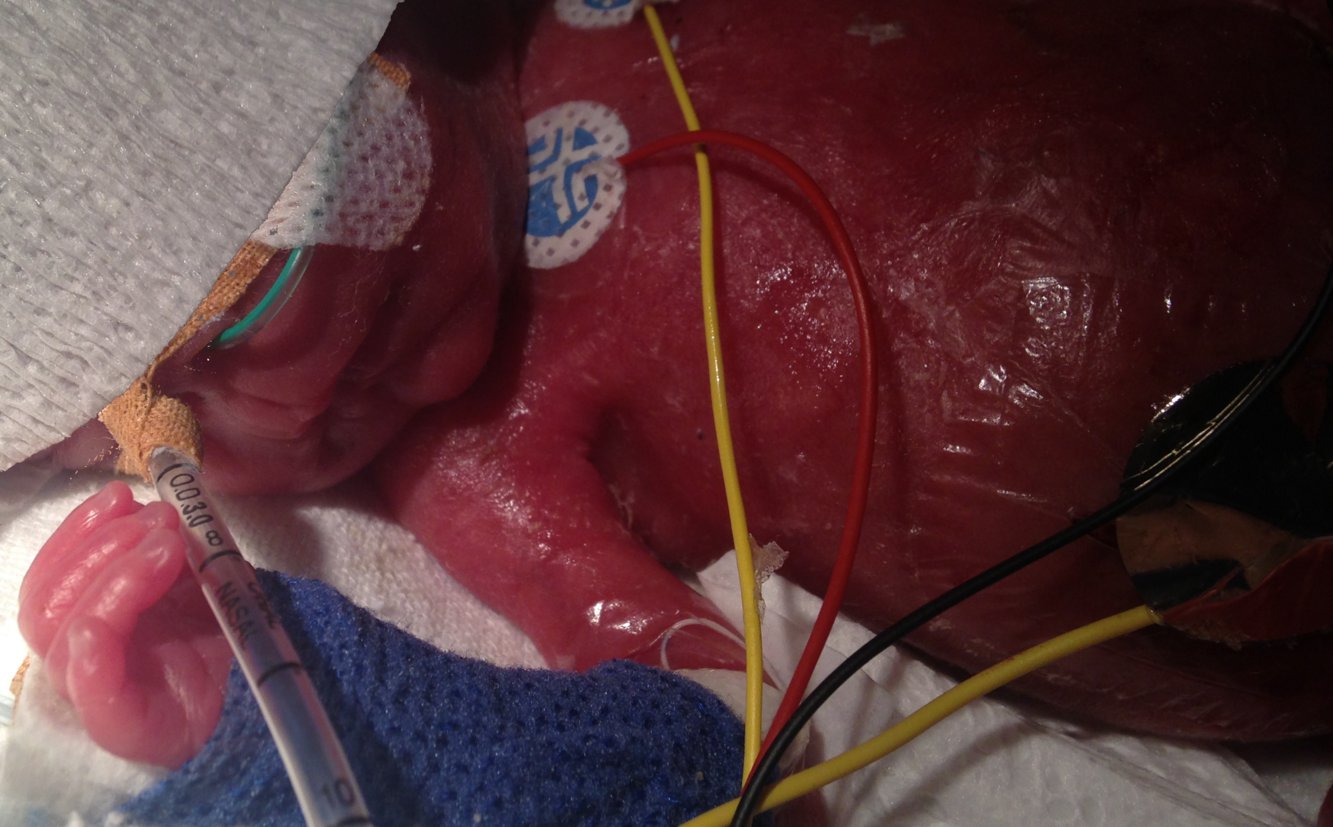
- Extremely low birth weight: birthweight < 1000 g regardless of the gestational age


© AMBOSS
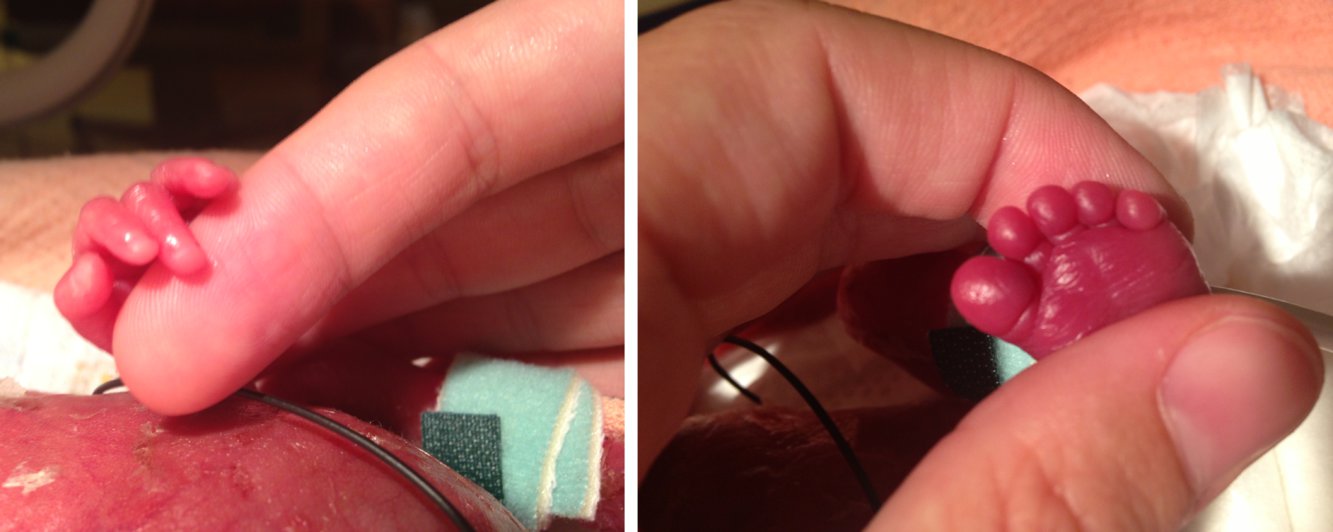
Preterm infant born at 23 weeks of gestation with approximate weight of 500 g. The immature skin is very thin, transparent, and sensitive.
© AMBOSS
Postdelivery care and Apgar score
Postdelivery care of the newborn [9]
- Perform initial neonatal assessment.
- Initiate skin-to-skin contact between newborn and birthing parent.
- Encourage early initiation of breastfeeding.
- Consider delaying umbilical cord clamping for ≥ 30 seconds. [10]
- Clamp and cut the umbilical cord.
- Provide additional interventions as needed, e.g.:
- Clear airway secretions by wiping the newborn's mouth and nose.
- Dry and stimulate the newborn.
- Provide warmth.
- Assess the Apgar score 1 and 5 minutes after birth.
Apgar score [11]
-
Used for standardized clinical assessment of newborns at 1 and 5 minutes after birth
- Five components: skin color, heart rate, reflex irritability to tactile stimulation, muscle tone, respiratory effort
- Each component is given 0–2 points, depending on the status of the newborn.
- The total Apgar score is the sum of all five components.
- Assessing the need for and beginning neonatal resuscitation should be done independently of and before the Apgar score is determined.
-
Assessment of the Apgar score at 5 minutes: Infants with scores < 7 may require further intervention.
- Reassuring: 7–10
- Moderately abnormal: 4–6
- Low: 0–3
- In infants with a score below 7, the Apgar assessment is performed at 5-minute intervals for an additional 20 minutes.
- Persistently low Apgar scores are associated with long-term neurologic sequelae.
| Calculation of the Apgar score | |||
|---|---|---|---|
| 0 points | 1 point | 2 points | |
| Appearance (skin color) | Blue (cyanotic) or pale | Pink trunk, blue extremities (acrocyanosis) | Pink body and extremities |
| Pulse (heart rate) | None | < 100 beats/min | ≥ 100 beats/min |
| Grimace (reflex irritability upon tactile stimulation) | None | Grimace | Cry or active withdrawal |
| Activity (muscle tone, movement) | No movement, limp body | Some flexion | Active motion, flexion |
| Respirations | None | Weak cry, irregular/slow/weak breathing or gasping | Regular breathing, strong cry |
APGAR: Appearance, Pulse, Grimace, Activity, Respirations
The Apgar score is useful for evaluating the status of a newborn infant, but it should not be used to draw conclusions about individual neonatal morbidity or mortality, and it should not be used as a long-term prognostic tool.

Preventive measures directly after birth
- Ophthalmic antibiotics: to prevent gonococcal conjunctivitis (erythromycin ophthalmic ointment)
- Vitamin K: to prevent vitamin K deficiency bleeding of the newborn (VKDB)

Assessment of the newborn
Measurement and a detailed examination of the newborn should take place within the first 24 hours of life.
-
Measurements [12]
- Normal range (10th to 90thpercentile at 40 weeks gestation)
- Length: ∼ 50 cm (48–53 cm)
- Weight: ∼ 7.5 lb (6 lb 6 oz to 8 lb 9 oz)
- Boys: 6 lb 6 oz to 8 lb 9 oz
- Girls: 6 lb 2 oz to 8 lb 6 oz
- Head circumference: ∼ 35 cm (13–14.6 in)
-
Vital signs [13]
- Respiratory rate: 40–60 breaths per minute
- Heart rate: 120–160 beats per minute
- Bilirubin: see ”Neonatal jaundice”
- pH: ≥ 7.2 (slightly more acidic than adults) [14]
-
Urine and meconium [15]
- First passage of urine within 24 hours of birth
- First passage of meconium; (a black-green, tarry substance that forms the newborn's feces) within 48 hours after birth
- Feeding: encourage and provide counseling regarding breastfeeding
-
Losing weight after birth [16]
- Loss of up to 7% of birth weight in first five days of life is normal and no specific treatment is required.
- Newborns normally regain their birth weight by the time they are 10–14 days old.
- For causes of small-for-gestational-age infants, see “Intrauterine growth restriction.”
-
Consequences of intrauterine estrogen exposure
- Breast bud development is normal in newborns, independent of sex.
- Newborn girls may have bloody mucoid vaginal discharge.
The physiological respiratory rate and heart rate of newborns are substantially higher than in adults and older pediatric patients.
Healthy newborns normally lose up to 7% of their original birth weight in the first 5 days of life. This weight is then gained back through drinking breast milk and/formula by age 10–14 days. No treatment is necessary.
External signs of maturity
Gestational age is estimated at birth with the Ballard score, which combines neuromuscular assessment with the following physical signs of maturity: [17]
- Skin color and texture: rosy
- Body hair: lanugo may be present, thinning, or mostly absent
- Eyes: open
- Ears: well-formed pinna (auricular cartilage) that instantly recoils
- Breast: clearly discernible areola
- Testicles: descended
- Labia: labia minora covered by labia majora
- Plantar creases: cover the entire soles of the feet
Examination for abnormalities
For an overview of potential abnormal examination findings, see “Overview of neonatal conditions.”
Face and head [17]
- Look for dysmorphic facial features.
- Check head shape (including cranial sutures and fontanelles).
- Perform an eye examination including the Bruckner test for red reflex. [18]
- Visualize and palpate the oral palate for cleft palate.
- Check the tongue for ankyloglossia.
- Check for ear abnormalities; low-set ears are often associated with genetic disorders.
- Assess hearing function (see “Newborn hearing screening”).
Intermittent strabismus is a normal finding in children < 4 months of age. [19]
Spine and nervous system [20]
- Assess the neck.
- Look for webbing, cysts, pits, masses, and branchial clefts.
- Ensure there is full range of movement.
- Examine the spine.
- Perform a full neurological examination including assessment of tone.
Thorax [17][20]
- Palpate clavicles to exclude neonatal clavicle fracture.
- Look for skeletal deformities (e.g., pectus excavatum) and check for neonatal gynecomastia.
- Look for symmetric movement, and auscultate the chest to detect neonatal pneumothorax.
-
Assess for congenital cardiac defects (see also “Newborn screening”).
- Auscultate for heart sounds.
- Perform pulse oximetry to exclude cyanotic cardiac defects.
- Palpate the brachial and femoral pulses to evaluate for coarctation of the aorta. [21]
Abdomen [20]
- Check that the abdomen is not distended or scaphoid.
- Palpate the abdomen for masses and organomegaly.
- Auscultate for bowel sounds.
- Check the umbilical cord.
- Ensure there are two arteries and one vein; a single umbilical artery can be associated with other congenital abnormalities.
- Look for signs of bleeding/infection.
Genitourinary examination [20]
- Assess for an imperforate anus.
- Check the inguinal region for hernias.
- In males infants: Rule out cryptorchidism, congenital hydrocele, and hypospadias.
- In female infants: Assess for labial adhesions and abnormalities of the hymen.
Extremities [20]
- Check the fingers and toes for supernumerary, absent, or deformed digits.
- Assess the range of motion of all extremities.
- Perform an infant hip examination (e.g., with Ortolani maneuver) to rule out developmental dysplasia of the hip.
- Look for signs of neonatal brachial plexus injury.
Skin [20]
- Look for signs of neonatal jaundice.
- Carefully inspect all of the skin for neonatal skin lesions (including birthmarks).
Newborn screening
- Before leaving the hospital, newborns should be screened for serious and life-threatening conditions.
- The optimal time for screening is 24–48 hours after birth. [22]
- Screening usually involves assessment for:
- Critical congenital cardiac defects
- Hyperbilirubinemia
- Congenital deafness
- Various genetic disorders, e.g., endocrine, metabolic, and hematological disorders
Which genetic disorders to screen for varies according to national and state law; check local guidelines.
Overview of screening for newborns [23][24]
| Newborn recommended screening [23][24] | |||
|---|---|---|---|
| Conditions to screen | Recommended ages | Method of screening | Actions for abnormal findings |
| Congenital metabolic or hematological disorders |
|
|
|
| Hyperbilirubinemia |
|
|
|
| Critical Congenital Heart Defects (CCHD) |
|
|
|
| Congenital deafness [25] |
|
|
|
Examples of commonly screened genetic conditions
-
Endocrine conditions
- Congenital hypothyroidism
- Congenital adrenal hyperplasia
-
Metabolic conditions
- Disorders of fatty acid metabolism
- Disorders of organic acid metabolism (e.g., isovaleric acidemia, methylmalonic acidemia, propionic acidemia)
- Disorders of amino acid metabolism; (e.g., phenylketonuria, homocystinuria, maple syrup urine disease, citrullinemia type I)
- Hemoglobinopathies (e.g., sickle cell disease, beta thalassemia)
-
Other conditions
- Cystic fibrosis
- Classical galactosemia
- Severe combined immunodeficiencies (SCID)
- Glycogen storage disease type II (Pompe disease)
- Mucopolysaccharidosis type I
- X-linked adrenoleukodystrophy
- Spinal muscular atrophy
-
Biotinidase deficiency
- Etiology: metabolic disorder that leads to biotin deficiency
- Clinical features: dermatitis, CNS damage
- Treatment: biotin substitution
External Resources
References
- "Child growth standards". https://www.who.int/tools/child-growth-standards/standards. [2021-01-01]
- "Assessments for Newborn Babies". https://www.stanfordchildrens.org/en/topic/default?id=assessments-for-newborn-babies-90-P02336. [2021-01-01]
- Yeh P, Emary K, Impey L. "The relationship between umbilical cord arterial pH and serious adverse neonatal outcome: analysis of 51,519 consecutive validated samples.". BJOG. 119(7). :824-31. (2012)
- American Academy of Pediatrics. "Newborn: First Stool and Urine". Pediatrics in Review. 15(8). :319-320. (1994)
- McInerny TK, Foy JM, Adam HM. "American Academy of Pediatrics Textbook of Pediatric Care". American Academy of Pediatrics. (2016). ISBN: 9781581109665
- Lewis ML. "A comprehensive newborn exam: part I. General, head and neck, cardiopulmonary". Am Fam Physician. 90(5). :289-96. (2014)
- Loh AR, Chiang MF. "Pediatric Vision Screening". Pediatr Rev. 39(5). :225-234. (2018)
- Donahue SP, Baker CN, Simon GR, et al. "Procedures for the Evaluation of the Visual System by Pediatricians (reaffirmed 2022)". Pediatrics. 137(1). (2016)
- Lewis ML. "A comprehensive newborn exam: part II. Skin, trunk, extremities, neurologic". Am Fam Physician. 90(5). :297-302. (2014)
- Lannering K, Bartos M, Mellander M. "Late Diagnosis of Coarctation Despite Prenatal Ultrasound and Postnatal Pulse Oximetry". Pediatrics. 136(2). :e406-e412. (2015)
- Aziz K, Lee HC, Escobedo MB, et al. "Part 5: Neonatal Resuscitation: 2020 American Heart Association Guidelines for Cardiopulmonary Resuscitation and Emergency Cardiovascular Care". Circulation. 142(16_suppl_2). (2020)
- Yamada NK, Szyld E, Strand ML, et al. "2023 American Heart Association and American Academy of Pediatrics Focused Update on Neonatal Resuscitation: An Update to the American Heart Association Guidelines for Cardiopulmonary Resuscitation and Emergency Cardiovascular Care". Circulation. 149(1). (2024)
- Watterberg KL, Aucott S, Ecker JL et al. "The Apgar Score". Pediatrics. 136(4). (2015)
- Abhyankar S, Lloyd-Puryear MA, Goodwin R, et al. "Standardizing newborn screening results for health information exchange". AMIA Annu Symp Proc. 2010. :1-5. (2010)
- Hagan JF, Shaw JS, Duncan PM. "Bright Futures: Guidelines for Health Supervision of Infants, Children and Adolescents, 4th Edition". American Association of Pediatrics. (2017). ISBN: 9781610020220
- "Recommendations for Preventive Pediatric Health Care". https://web.archive.org/web/20230126132131/https://downloads.aap.org/AAP/PDF/periodicity_schedule.pdf. [2022-07-01]
- The Joint Committee on Infant Hearing. "Year 2019 Position Statement: Principles and Guidelines for Early Hearing Detection and Intervention Programs". Journal of Early Hearing Detection and Intervention. 4(2). :1-44. (2019)
- "Infant Timeline". https://www.aap.org/en-us/advocacy-and-policy/aap-health-initiatives/HALF-Implementation-Guide/Age-Specific-Content/Pages/Infant-Timeline.aspx. [2021-01-01]
- "Newborns: improving survival and well-being". https://www.who.int/news-room/fact-sheets/detail/newborns-reducing-mortality. [2020-09-19]
- "Maternal and Perinatal Health". http://www.who.int/maternal_child_adolescent/topics/maternal/maternal_perinatal/en/. [2018-01-01]
- "State Definitions of Live Births, Fetal Deaths, and Gestation Periods at which Fetal Deaths are Registered". https://books.google.de/books?id=I_BLt5IwZw8C&printsec=frontcover&source=gbs_ge_summary_r&cad=0#v=onepage&q&f=false. [1966-01-01]
- American College of Obstetricians and Gynecologists. "ACOG Committee Opinion: Definition of term pregnancy". Obstet Gynecol. 122(5). :1139-1140. (2013)
- Quinn JA, Munoz FM, Gonik B, et al. "Preterm birth: Case definition & guidelines for data collection, analysis, and presentation of immunisation safety data.". Vaccine. 34(49). :6047-6056. (2016)
- Schlaudecker EP, Munoz FM, Bardají A, et al. "Small for gestational age: Case definition & guidelines for data collection, analysis, and presentation of maternal immunisation safety data.". Vaccine. 35(48 Pt A). :6518-6528. (2017)
- "Newborns with low birthweight". https://www.who.int/whosis/whostat2006NewbornsLowBirthWeight.pdf. [2006-01-01]
- "Gestational Assessment". http://www.chop.edu/conditions-diseases/gestational-assessment. [2017-01-01]
- "Preterm Birth Fact Sheet". http://www.who.int/mediacentre/factsheets/fs363/en/. [2016-11-01]
- "Intraventricular Hemorrhage (IVH) ". https://www.ucsfbenioffchildrens.org/pdf/manuals/49_IntraventricularHem.pdf. [2004-01-01]
- "Premature Birth". http://www.mayoclinic.org/diseases-conditions/premature-birth/basics/definition/con-20020050. [2014-11-27]
- "Reproductive Health - Preterm Birth". https://web.archive.org/web/20170513085140/https://www.cdc.gov/reproductivehealth/maternalinfanthealth/pretermbirth.htm. [2016-11-10]
- Meni C. "Infantile hemangioma: Epidemiology update". J Am Acad Dermatol. 68(4). :AB95. (2013)