CME information and disclosures
To see contributor disclosures related to this article, click on this reference: [1]
Physicians can earn CME/MOC credit by using this article to address a clinical question and completing a brief evaluation about how they applied the information in their practice.
AMBOSS designates this internet point-of-care activity for a maximum of 0.5 AMA PRA Category 1 Credit(s)™. Physicians should claim only the credit commensurate with the extent of their participation in the activity.
For answers to questions about AMBOSS CME, including how to redeem CME/MOC credit, see “Tips and links” at the bottom of this article.
Quick guide
Diagnostic approach
- Targeted clinical evaluation; usually no testing indicated
- Disease-specific (e.g., streptococcus, COVID-19) rapid test or PCR if there is high suspicion
- Respiratory viral panel if there is atypical presentation or diagnostic uncertainty
- Neck imaging if croup (AP x-ray) or epiglottitis (lateral x-ray or CT with contrast) is suspected


Red flag features
- Worsening symptoms after initial improvement
- Trismus
- Drooling
- Muffled voice
- Signs of respiratory distress
- Clinical features of sepsis
Management checklist
- Start disease-specific management if underlying pathogen is identified (e.g., antibiotics for GAS pharyngitis).
- Rest and hydration
- Avoid irritants to the upper respiratory tract (e.g., tobacco products and alcohol).
- Ibuprofen and/or acetaminophen as needed for pain and/or fever
- Honey or throat lozenges
- Head of the bed elevation
- Warm packs to the face
- Saline irrigation
- Consider short course of intranasal decongestants, e.g., oxymetazoline.
- Consult ENT or anesthesia immediately if patients have signs of airway compromise or signs of respiratory distress.
Life-threatening causes
- Pertussis in infants < 6 months of age
- Epiglottitis
- Severe influenza
- Severe COVID-19
This calculator is provided by the third-party QXMD, who is solely responsible for its content and functionality.
Created by: QxMD.
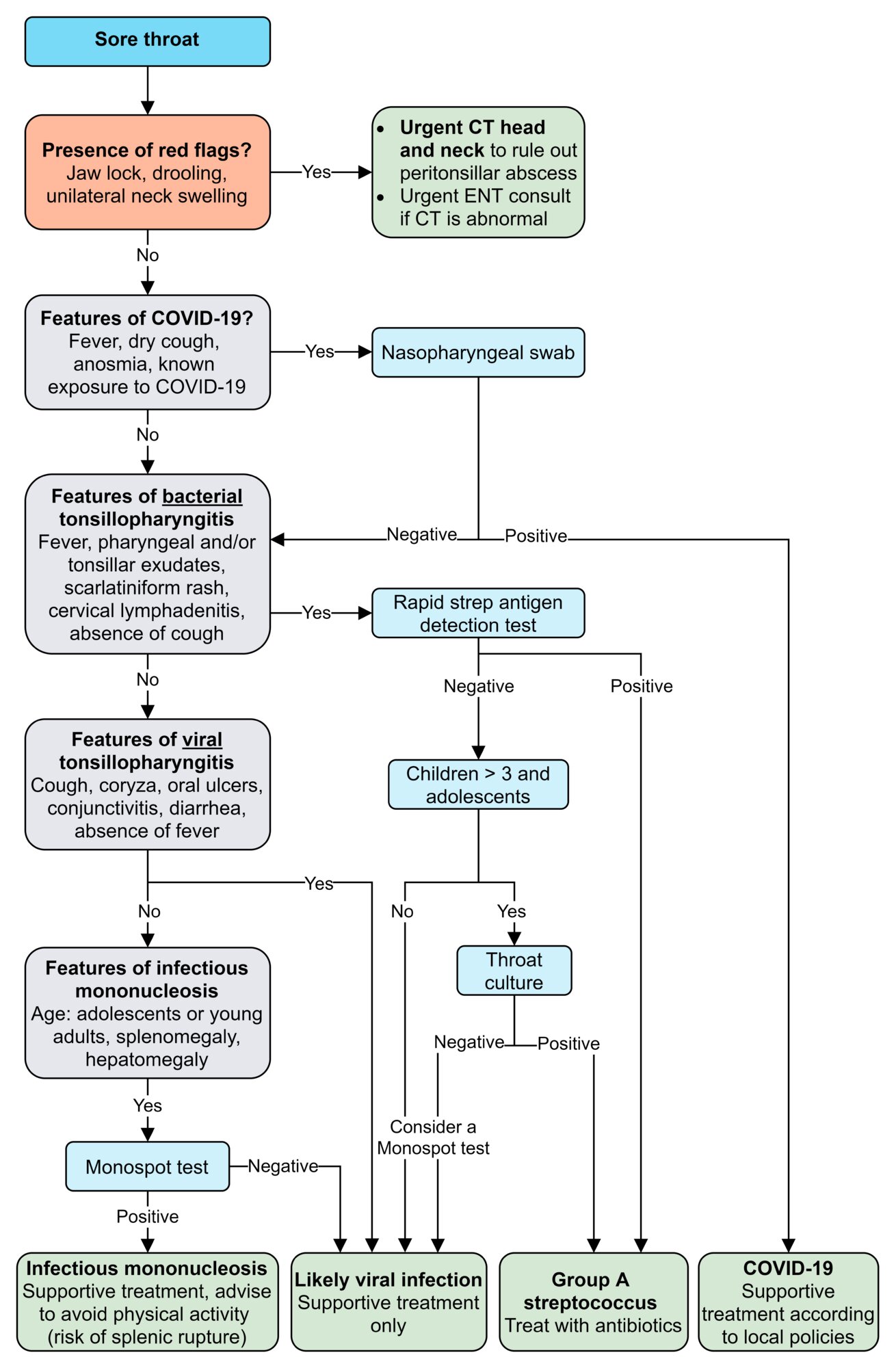
© AMBOSS
Summary
Upper respiratory tract infections (URTIs) involve structures at or above the vocal cords, e.g., the nasal cavity, sinuses, pharynx, and/or larynx. URTIs include the common cold, acute rhinosinusitis, pharyngitis, laryngitis, influenza, croup, and COVID-19. Most URTIs are caused by viruses such as the rhinovirus. URTIs more commonly occur in the fall and winter and are especially common in children. Typical clinical manifestations include rhinorrhea, nasal congestion, sore throat, and cough. Diagnosis is generally clinical, although diagnostic testing may be performed to assess for specific infections (e.g., influenza, COVID-19, group A streptococcal pharyngitis). In most cases, treatment is supportive, with symptoms typically resolving within 14 days. Antibiotics are not indicated unless there is a confirmed bacterial infection.
Epidemiology
- More commonly occur in the fall and winter [2]
- Higher incidence in children than adults [3]
- Children: 6–10 per year
- Adults: 2–4 per year
Epidemiological data refers to the US, unless otherwise specified.
Etiology
Most URTIs are caused by viruses. [4]
Viral
- Rhinovirus
- Coronavirus
- Influenza virus [3]
- Respiratory syncytial virus (RSV)
- Adenovirus
- Parainfluenza virus
- Human metapneumovirus
- Epstein-Barr virus
- Enterovirus
Bacterial
- Streptococcus pneumoniae
- Streptococcus pyogenes
- Haemophilus influenzae
- Mycoplasma pneumoniae
- Moraxella catarrhalis
Many of the pathogens that cause URTI can also cause lower respiratory tract infections (LRTIs). [2][4]
Clinical evaluation
Focused history
- Symptom duration: typically ≤ 14 days [3]
-
Common features of URTI [3]
- Sore throat
- Nasal congestion
- Rhinorrhea (with or without purulence)
- Cough
- Fever (esp. among pediatric patients)
-
Exposures
- Recent travel history
- Contact with infectious individuals in the past week [3]
- Vaccination status: e.g., COVID-19 vaccination, Hib vaccination, influenza vaccination
- Targeted review of systems: e.g., HEENT, pulmonary
Focused physical examination
- Sinus, nose, and throat examination
- Pulmonary examination including assessment for pathological breath sounds
Fever is more common among pediatric than adult patients, and typically lasts for 2–3 days. [3]
Initial management
Outpatient treatment of URTI is appropriate for most patients; complications are rare.
Approach
- Check vital signs.
- Urgently evaluate patients with red flags for URTI to assess for:
- Life-threatening causes of URTI
- Complications, e.g., secondary bacterial infection
- Consult ENT or anesthesia immediately if patients have signs of airway compromise or signs of respiratory distress.
Red flags for URTI
- Worsening symptoms after an initial period of improvement [5]
- Trismus, drooling, muffled voice [6]
- Signs of respiratory distress [7][8]
- Clinical features of sepsis [8]
Life-threatening causes of URTI
- Pertussis in infants < 6 months of age
- Epiglottitis
- Severe COVID-19
- Severe influenza
Diagnosis
Most URTIs can be diagnosed clinically. Consider diagnostic studies in selected patients.
Nonspecific laboratory studies
-
Routine studies: to support the diagnosis and/or determine disease severity
-
CBC may show:
- Lymphopenia, e.g., in COVID-19 [9]
- Lymphocytosis, e.g., in pertussis, influenza, infectious mononucleosis [8][10][11]
- ESR and CRP may be elevated. [12]
- BMP and liver chemistries may show signs of end-organ damage in severe disease (e.g., severe COVID-19).
-
CBC may show:
- Blood cultures: Consider in severe disease (e.g., epiglottitis) to evaluate for concurrent bacteremia.
- ABG: Obtain in patients with signs of respiratory distress. [13][14]
Disease-specific laboratory studies
Consider specific studies based on clinical suspicion to support treatment and/or disposition decisions.
- Rapid strep test: : suspected acute bacterial tonsillopharyngitis
- Heterophile antibody test: : suspected infectious mononucleosis [11]
-
Disease-specific NAATs (e.g., PCR) in patients with:
- Indications for influenza testing [8]
- COVID-19 symptoms and/or known exposure [15]
- Suspected pertussis
- Risk factors for severe RSV infection
-
Respiratory viral panel
- Can differentiate between different viral etiologies of URTIs (e.g., influenza, parainfluenza, RSV)
- Not routinely indicated
- May be considered in certain patients, e.g.:
- Those with an atypical presentation
- If there is diagnostic uncertainty in suspected croup
Imaging
Consider imaging to support the diagnosis, determine disease severity, and/or evaluate for complications.
- Chest imaging (CXR or CT scan): to evaluate for pneumonia [16][17]
-
Neck imaging
- Anterior-posterior x-ray neck: to evaluate for croup [18]
- Lateral x-ray neck: to evaluate for epiglottitis in children [19]
- CT neck with IV contrast [20][21][22]
- Adults: to rule out differential diagnoses in patients with suspected epiglottitis
- Children: to rule out differential diagnoses and/or assess for congenital abnormalities in croup
- CT maxillofacial with or without IV contrast: in patients with red flags for rhinosinusitis
This calculator is provided by the third-party QXMD, who is solely responsible for its content and functionality.
Created by: QxMD.
Common causes of URTIs
| Common causes of URTIs [2][4][7][23] | ||||
|---|---|---|---|---|
| Condition | Most common pathogens | Clinical features | Diagnostic testing | Treatment |
| Common cold [24] |
|
|
|
|
| Influenza [8] |
|
|
|
|
| COVID-19 [25] |
|
|
|
|
| Acute rhinosinusitis [26] |
|
|
|
|
| Acute tonsillopharyngitis [27] |
|
|
|
|
| Laryngitis [3] |
|
|
|
|
| Epiglottitis [7] |
|
|
|
|
| Croup [2] |
|
|
|
|
| Pertussis [10] |
|
|
|
|
| Infectious mononucleosis [3] |
|
|
|
|
This calculator is provided by the third-party QXMD, who is solely responsible for its content and functionality.
Created by: QxMD.
Treatment
Outpatient treatment of URTI is appropriate for most patients; complications are rare.
General principles [2][23]
- Recommend rest and adequate hydration (e.g., 6–10 glasses of fluid a day).
- Advise patients to avoid smoking and alcohol use.
- Offer symptomatic treatment as needed.
- Provide specific treatment if indicated, e.g.:
- Treatment of influenza
- Management of COVID-19
- Antibiotics only for disease-specific indications (e.g., GAS pharyngitis)
- Counsel on return precautions.
Do not prescribe antibiotics without confirmation of a bacterial infection, as antibiotics do not treat viral infections and may cause harm, e.g., drug hypersensitivity reaction, C. difficile infection. [7]
Symptomatic treatment [2][23][29]
-
General
- Zinc (e.g., zinc acetate or gluconate lozenges) and probiotics (e.g., containing Lactobacillus casei) have been shown to shorten symptom duration. [30][31]
- Oral antihistamine/decongestant combinations may improve symptoms but can cause adverse effects, e.g., dry mouth and dizziness.
-
Rhinorrhea or sinus congestion
- Elevate the head of the bed to improve sinus drainage.
- Apply warm packs to the face for 5–10 minutes 3 times a day for facial pain. [2]
- Nasal saline irrigation
- Intranasal decongestants, e.g., oxymetazoline
- Pain or fever: analgesics, e.g., ibuprofen and/or acetaminophen
- Cough: nonpharmacological measures may be beneficial, e.g., honey [23][32]
Antitussives (e.g., codeine, dextromethorphan) and expectorants (e.g., guaifenesin) are not effective for URTI-associated cough. [29]
Return precautions [3]
- Dyspnea
- Chest pain
- Productive cough
- Fever > 38.9°C (> 102°F)
- Severe headache or facial pain
- Dizziness, confusion
- Symptom duration > 14 days (other than cough)
Differential diagnoses
-
Infectious
- LRTIs, e.g., pneumonia
- Acute HIV infection
- Measles
-
Noninfectious
- Allergic rhinitis
- Upper airway cough syndrome
- Vasomotor rhinitis
- Asthma exacerbation
- Gastroesophageal reflux disease
The differential diagnoses listed here are not exhaustive.
Complications
Most URTIs are mild and self-limited and rarely cause complications. [2]
- LRTIs
- Otitis media
- Secondary bacterial infection
- See also the respective articles for complications of specific causes of URTI, e.g.:
- Sinusitis complications
- Pertussis complications
We list the most important complications. The selection is not exhaustive.
Prevention
- Educate patients and caregivers on respiratory hygiene and hand hygiene.
- Recommend regularly cleaning and disinfecting surfaces that are touched often, e.g., door handles.
- Advise patients to stay at home until both:
- Afebrile for 24 hours without the use of antipyretics
- Symptoms are improving
- Ensure age-appropriate immunizations are up-to-date, including seasonal vaccines, e.g.:
- Influenza vaccination
- COVID-19 vaccination
- RSV vaccination
Related One-Minute Telegram
- One-Minute Telegram 107-2024-2/3: To mask or not to mask: wearing face masks may help prevent respiratory infections
Interested in the newest medical research, distilled down to just one minute? Sign up for the One-Minute Telegram in “Tips and links” below
External Resources
References
- Harris AM, Hicks LA, Qaseem A. "Appropriate Antibiotic Use for Acute Respiratory Tract Infection in Adults: Advice for High-Value Care From the American College of Physicians and the Centers for Disease Control and Prevention". Ann Intern Med. 164(6). :425-34. (2016)
- Loscalzo J, Fauci AS, Kasper DL, et al. "Harrison's Principles of Internal Medicine, Twenty-First Edition (Vol.1 & Vol.2)". McGraw-Hill Education / Medical. (2022). ISBN: 9781264268504
- Grief SN. "Upper Respiratory Infections". Primary Care: Clinics in Office Practice. 40(3). :757-770. (2013)
- Rothberg MB, Haessler SD. "Complications of seasonal and pandemic influenza". Crit Care Med. 38. :e91-e97. (2010)
- Weber R. "Pharyngitis". Prim Care. 41(1). :91-98. (2014)
- Sur DKC, Plesa ML. "Antibiotic Use in Acute Upper Respiratory Tract Infections". Am Fam Physician. 106(6). :628-636. (2022)
- Uyeki TM, Bernstein HH, Bradley JS, et al. "Clinical Practice Guidelines by the Infectious Diseases Society of America: 2018 Update on Diagnosis, Treatment, Chemoprophylaxis, and Institutional Outbreak Management of Seasonal Influenza". Clin Infect Dis. 68(6). :e1-e47. (2018)
- Wiersinga WJ, Rhodes A, Cheng AC, Peacock SJ, Prescott HC. "Pathophysiology, Transmission, Diagnosis, and Treatment of Coronavirus Disease 2019 (COVID-19)". JAMA. 324(8). :782. (2020)
- Kline JM, Lewis WD, Smith EA, Tracy LR, Moerschel SK. "Pertussis: a reemerging infection". American family physician. 88(8). :507-14. (2013)
- Womack J, Jimenez M. "Common questions about infectious mononucleosis". Am Fam Physician. 91(6). :372-6. (2015)
- Melbye H, Hvidsten D, Holm A, Nordbø SA, Brox J. "The course of C-reactive protein response in untreated upper respiratory tract infection". Br J Gen Pract. 54(506). :653-8. (2004)
- Greydanus DE, Patel DR, Reddy VN. "Handbook of Clinical Pediatrics". World Scientific. (2010). ISBN: 9789814280495
- Sanghani H, Bansal S, Parmar V, Shah R. "Study of Arterial Blood Gas Analysis in Moderate-to-Severe COVID-19 Patients". Cureus. (2022)
- "Interim Guidance for Antigen Testing for SARS-CoV-2". https://web.archive.org/web/20230427001750/https://www.cdc.gov/coronavirus/2019-ncov/lab/resources/antigen-tests-guidelines.html. [2022-05-05]
- Jokerst C, Chung JH, Ackman JB, et al. "ACR Appropriateness Criteria® Acute Respiratory Illness in Immunocompetent Patients". J Am Coll Radiol. 15(11). :S240-S251. (2018)
- "ACR Recommendations for the use of Chest Radiography and Computed Tomography (CT) for Suspected COVID-19 Infection". https://www.acr.org/Advocacy-and-Economics/ACR-Position-Statements/Recommendations-for-Chest-Radiography-and-CT-for-Suspected-COVID19-Infection. [2020-03-11]
- Blaney SM, Giardino AP, Orange JS, et al. "Rudolph's Pediatrics, 23rd Edition". McGraw-Hill Education / Medical. (2018). ISBN: 9781259588594
- Darras KE, Roston AT, Yewchuk LK. "Imaging Acute Airway Obstruction in Infants and Children". Radiographics. 35(7). :2064-2079. (2015)
- Smith MM, Mukherji SK, Thompson JE, Castillo M. "CT in adult supraglottitis". AJNR Am J Neuroradiol. 17(7). :1355-8. (1996)
- Smith DK, McDermott AJ, Sullivan JF. "Croup: Diagnosis and Management". Am Fam Physician. 97(9). :575-580. (2018)
- Vezzetti R, Carlson J, Pennington D. "Pediatric Imaging for the Emergency Provider E-Book". Elsevier Health Sciences. (2021). ISBN: 9780323708500
- DeGeorge KC, Ring DJ, Dalrymple SN. "Treatment of the Common Cold". Am Fam Physician. 100(5). :281-289. (2019)
- Smith SM, Schroeder K, Fahey T. "Over-the-counter (OTC) medications for acute cough in children and adults in community settings.". Cochrane Database Syst Rev. :CD001831. (2014)
- Singh M, Das RR. "Zinc for the common cold". Cochrane Database Syst Rev. (2013)
- Zhao Y, Dong BR, Hao Q. "Probiotics for preventing acute upper respiratory tract infections". Cochrane Database Syst. Rev. 2022(8). (2022)
- Abuelgasim H, Albury C, Lee J. "Effectiveness of honey for symptomatic relief in upper respiratory tract infections: a systematic review and meta-analysis". BMJ Evid Based Med. 26(2). :57-64. (2020)
- Jameson JL, Fauci AS, Kasper DL, et al. "Harrison's Principles of Internal Medicine, Twentieth Edition (Vol.1 & Vol.2)". McGraw-Hill Education / Medical. (2018). ISBN: 9781259644030
- Cheng AM, Dollar E, Angier H. "Outpatient Management of COVID-19: Rapid Evidence Review.". Am Fam Physician. 107(4). :370-381. (2023)
- Rosenfeld RM, Piccirillo JF, Chandrasekhar SS et al. "Clinical practice guideline (update): Adult sinusitis". Otolaryngol Head Neck Surg. 152(2S). :S1-S39. (2015)
- Shulman et al. "Clinical Practice Guideline for the Diagnosis and Management of Group A Streptococcal Pharyngitis: 2012 Update by the Infectious Diseases Society of America". Clinical Infectious Diseases. 55(10). :e86–e102. (2012)
- "Pertussis (Whooping Cough) - Specimen Collection". https://web.archive.org/web/20150905194213/https://www.cdc.gov/pertussis/clinical/diagnostic-testing/specimen-collection.html. [2015-09-08]
- "Contributor Disclosures - Upper respiratory tract infection. All of the relevant financial relationships listed for the following individuals have been mitigated: Jan Schlebes (medical editor, is a shareholder in Novo Nordisk, and was a shareholder in Fresenius SE & Co KGaA through Nov 2024). None of the other individuals in control of the content for this article reported relevant financial relationships with ineligible companies. For details, please review our full conflict of interest (COI) policy"